
11 - Three Guest Practices (#3)
Hanna Sybille Müller's Choreographic Garden
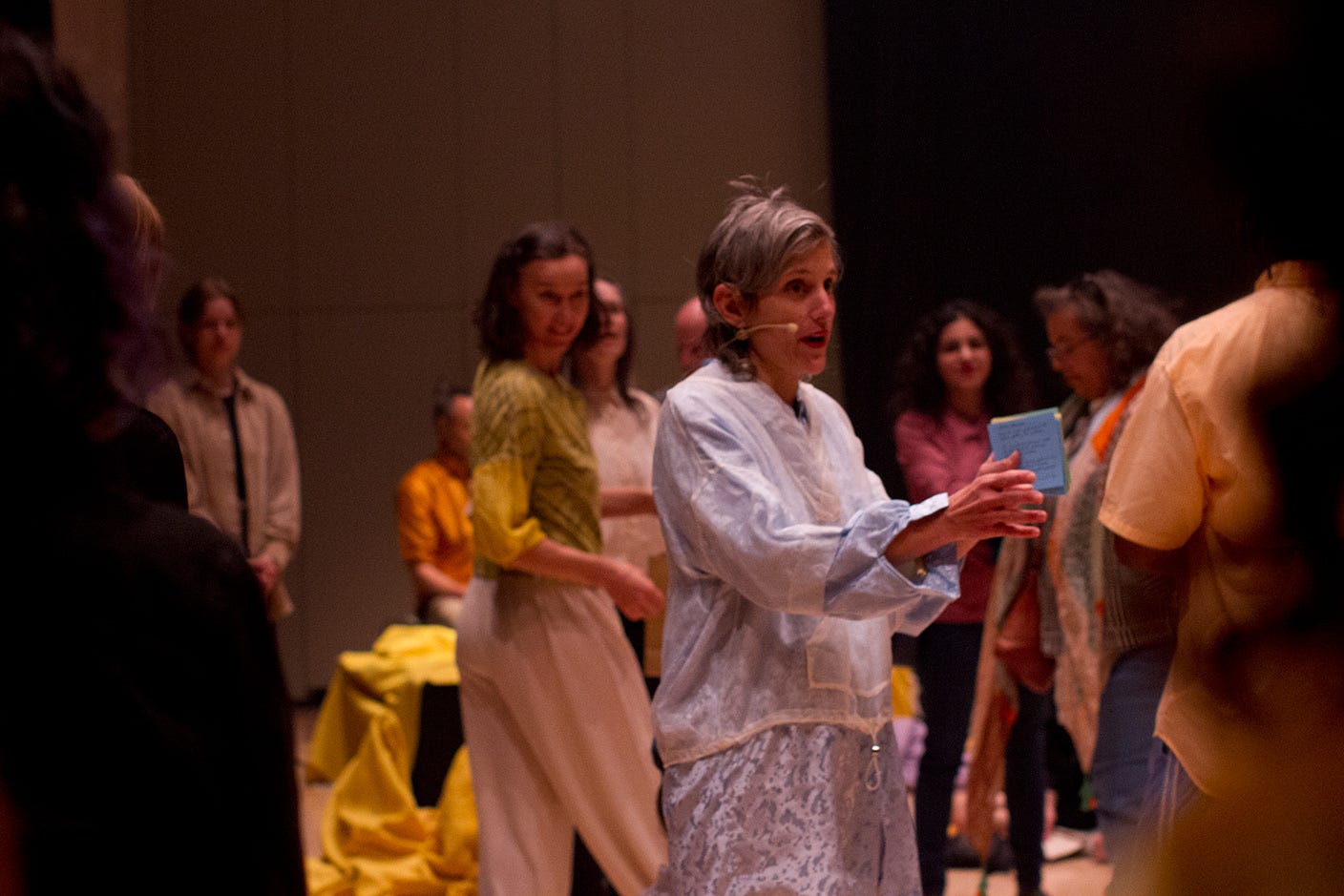
Choreographers Hanna Sybille Müller and Diego Gil came to class to discuss Hanna Sybille’s work in progress The Choreographic Garden. I will discuss this project, reflect on my peripheral participation, and share student contributions. Sybille and Diego came with video to present, but mostly some collective writing games which were used to generate, through play, a discussion about their mode of choreographic practice or generation of process. Originally from Germany, with a practice based in Berlin, Hanna Sybille Müller (link) now works in Montreal. Her previous work, Polymorphic Microbe Bodies (2023) was a multi-sensory dance work where the audiences are invited to lie down, close their eyes, and take a somatic journey into the microbial worlds inside their bodies - “by de-emphasizing sight, the work proposes an experience of dance that is not just visual, but perceived through sound, vibration, smell, taste and sensation.”
Diego Gil (link) has also been delicately uprooted and transplanted to Montreal (from Argentina), a choreographer and performer in his own right and also a scholar of philosophy, in particular the area of Process Philosophy. He has been working with Hanna Sybille Müller as dramaturge and outside eye (or outside [of] mind or outside [of] body) as a reflective contributor to this new work they are simultaneously developing and performing. This ‘outside’ of eye or ‘outside’ of mind or ‘outside’ of body can serve as a clue to what is a both whimsical and serious attempts in this work to free itself from image/representational culture and a certain subjective rationale of thought or instrumental outcome. This resonates with the work of Mindy Yan Miller discussed in the previous post, where I said that the communication syntax (the meaning-delivery) of the information, entertainment, and food industries must all be very similar - they exist in semantic co-dependence. Sybille’s work also resists our semantic co-dependence with this designed world but on a different register, as an attempt to be both with and outside the thinking, image-generating body. Can we stop image-generating long enough to explore being. Can we stop being (in such an subjective and exploring way) to experience the flow of ‘the active layer’ of living matter. Can we stop experiencing in this ‘human’ mode of experience? Then what? And so on. This feels like a meditation procedure, but in the earth. In the earth in a liquid state. To borrow a contemporary anthropology term, can we be participant-observers in the earth or active layer?
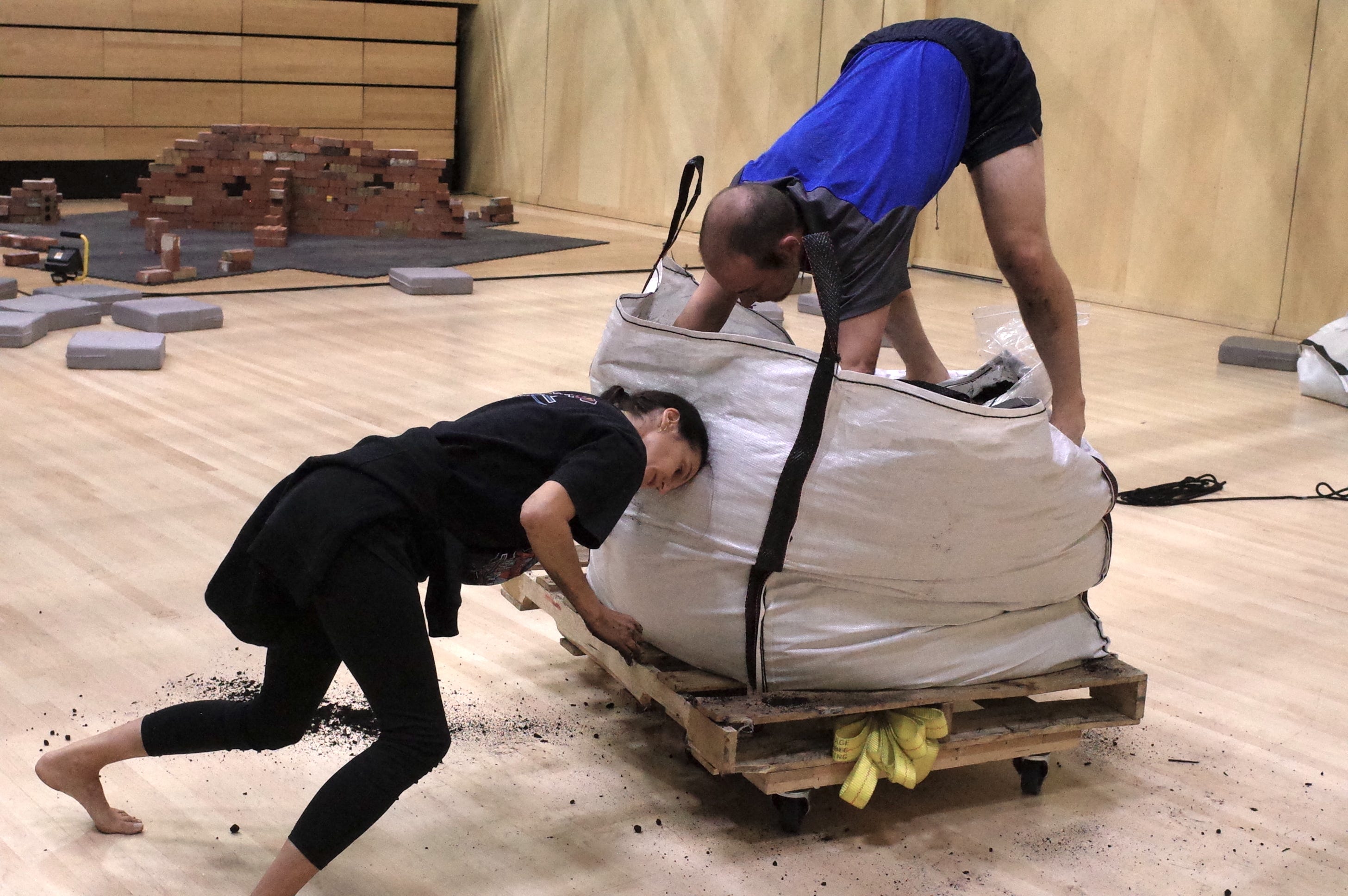
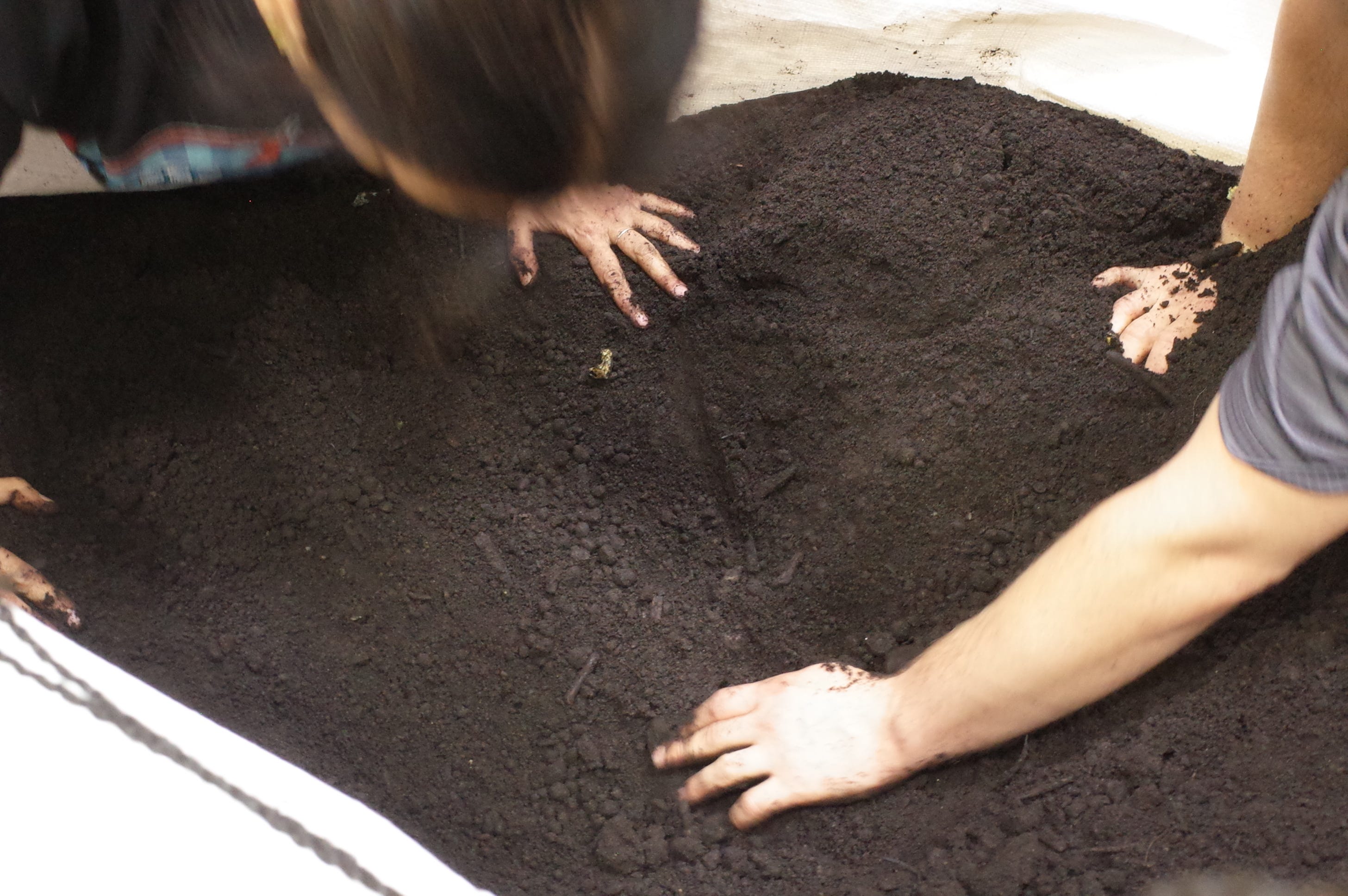
The Choreographic Garden is not a single performance, within the conventions of dance and theatre, but rather a series of movement based researches or collective gestures of curiousity which extend the thinking about forms of dance process embedded in Polymorphic Microbe Bodies. The first version took place at Musée d'art de Joliette involved the transformation of a space in front of the museum into a garden - a choreographic garden, framed as a ‘Continuum somatic practice’ which “explores the fluidity common to the bodies and life around us.” There were also one-on-one , back-to-back performative encounters between viewers and performers. The second public iteration was a residency and performance at a Montreal dance space (Tangente). For a couple of weeks Sybille and Diego along with performers Maria Kefirova and Nate Yaffe, sound artist Damaris Baker and myself (as object designer) worked together through an evolving series of writing, reading, sound and somatic experiments involving (and not involving) 500 kilos of earth transposed into the theatre space. I was the caretaker or ‘concierge of dirt’ (and the nylon materials handling bags we used to move it around). This involved a lot of sweeping and shoveling. A funny job, constantly cleaning up and and allowing the earth to escape again. An invisible and not so invisible guardian of the boundary between order and disorder. It reminds me of the seen and not-seen shrouded puppeteers of Japanese Bunraku performance. Through two weeks all of us participated equally in the movement work, the writing work and the discussions and at the end there was a public presentation framed as an open studio which involved repeating the looping process of reading, discussing, moving and sounding with a migrating audience in the space.
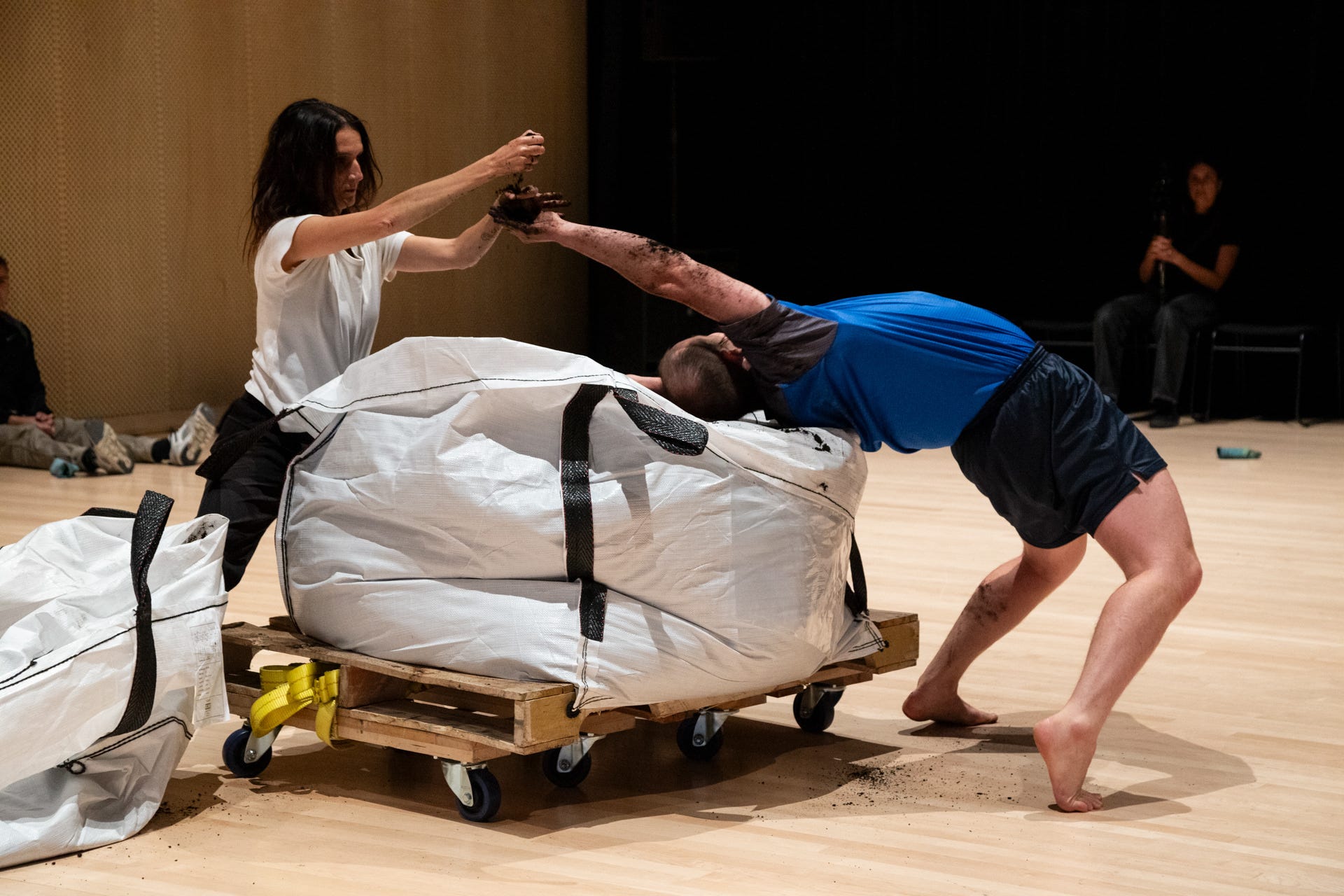
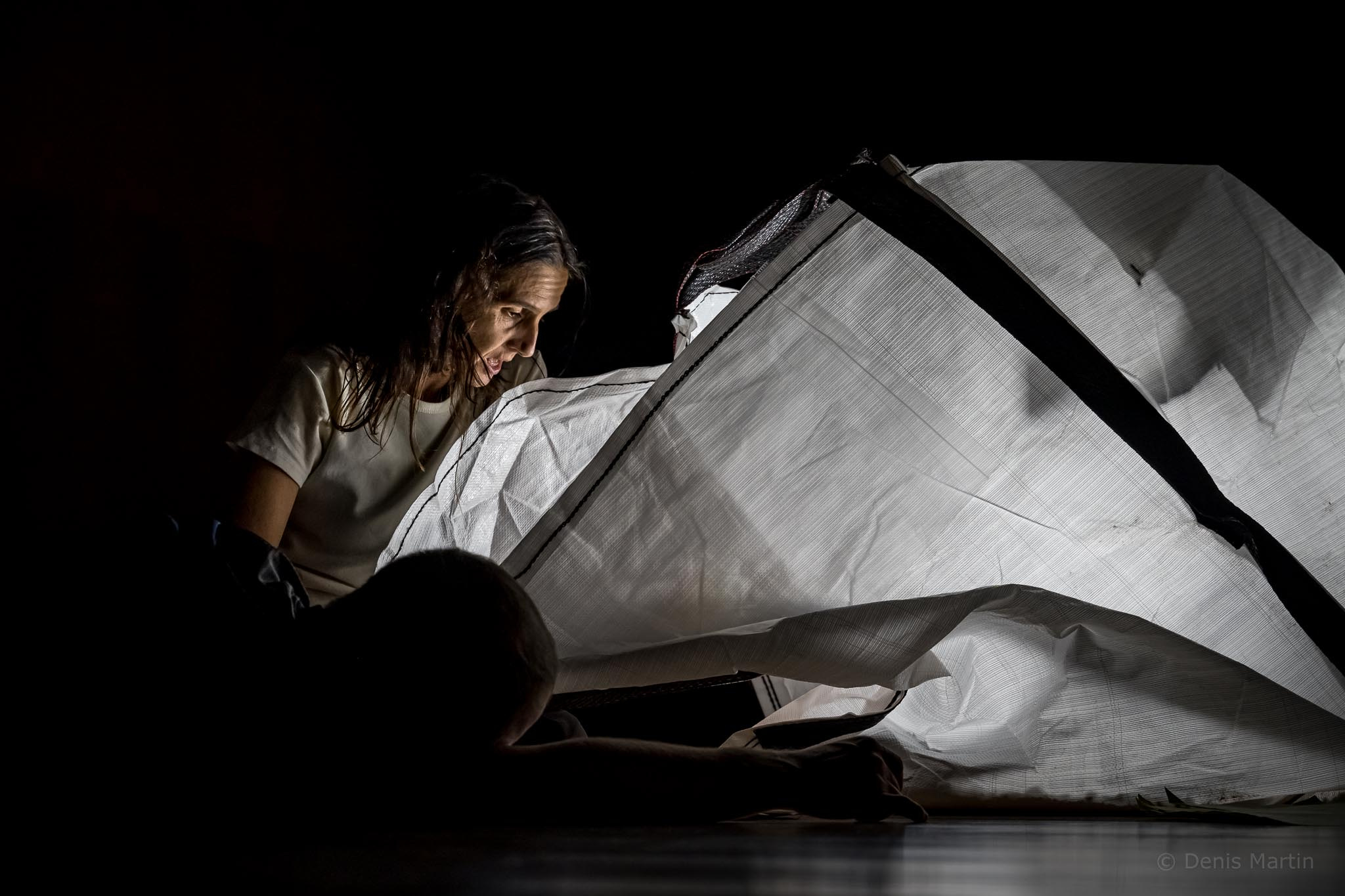
A reading/writing exercise in the workshop becomes an improvised script, a source of words and noun/verb phrases. A script in the hands of Maria and Nate, fragmented and broken down, like compost. An idea of lichen as a symbiotic combination of different organisms (from Sheldrake’s Entangled Life). Words, moistened and syntax-torn. A pushing of dirt contained in large (very crisp and noisy) nylon material handling bags (as used in the construction industry). The performers move in two empty bags and meet through the bags. These bags themselves ‘perform’ as what they are, as containment technology. The world we know is based on containment. The container is making inside and outside out of everything. Dragging, pushing, rolling - too much and to heavy to handle. Next, a perambulation, a walking dialogue of two microphone equipped and amplified voices (of performers Nate and Maria) around and out of the space with sound brought back into the theatre as disembodied voices mingling with abstractions of decomposed sound from Damaris’ collection of resonating things. After ten or twenty minutes Nate and Maria are back in the theatre and re-encountering the bag of dirt, digging in it with hands and shoulders, spilling it, wording it (the amplified dialogue continues). A physical dialogue between the performers and with the earth that is between them. The earth is slipping out of the bags. Moments of spillage. More and more. Colonizing the space. You can smell the earth. Sybille and Diego are watching, writing, thinking. There is a pause (there are two other groups sharing this performance evening - our works are alternating). Andrew and Diego carefully sweep all the earth from the floor. Other performances are ongoing. Nate, Maria, Damaris and Sybille sit in the middle of the space quietly discussing what to do, what they have done, how they have done. Members of the audience come close to hear and speak. Has the performance ended? The performance has brought sitting and chatting into its range. And off again. And again. And again.
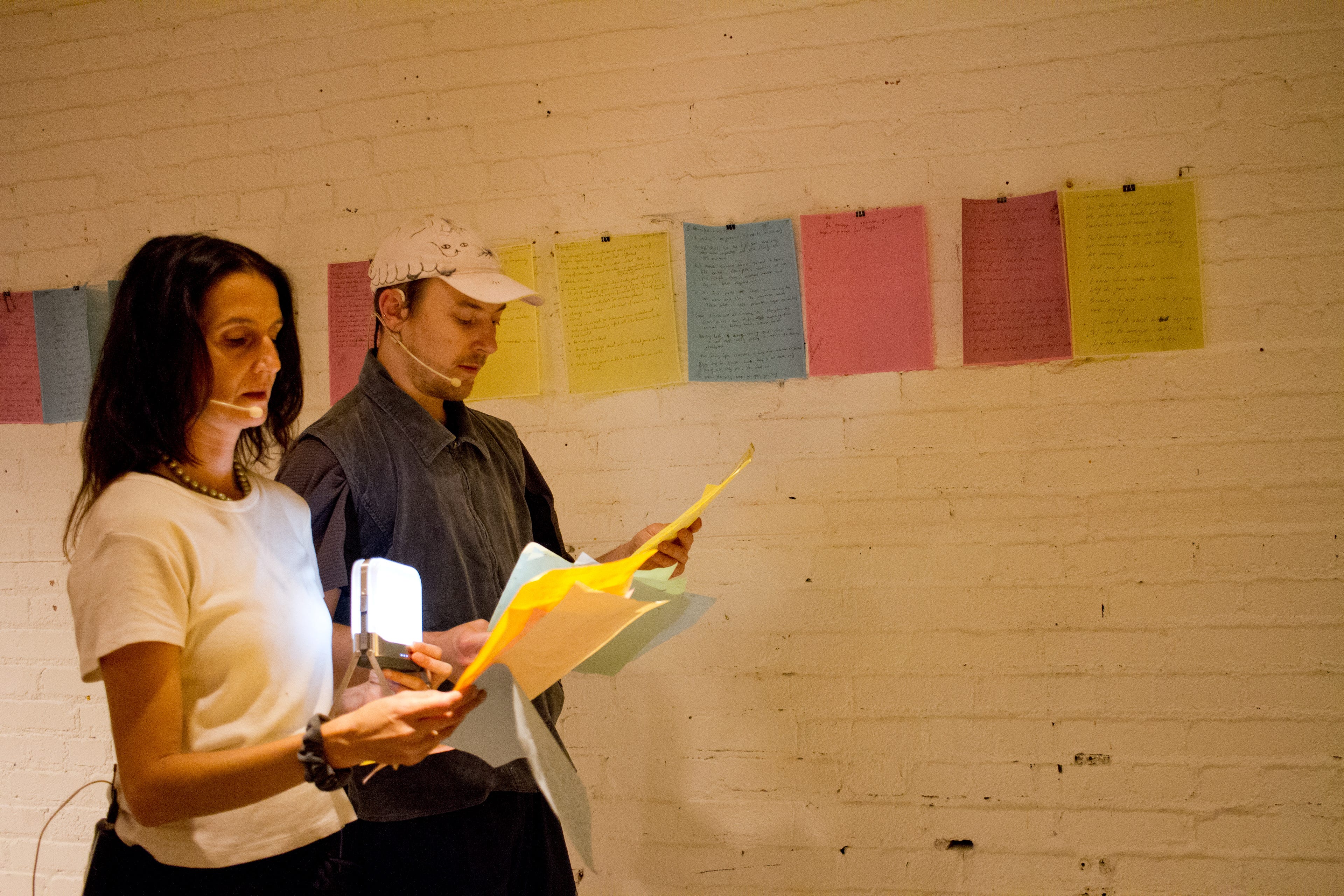
Back to the the classroom again, Sybille and Diego explain themselves by showing some video and engaging the students in a collective writing exercise. Texts are composed and passed on the be continued by others. In my imagination the term ‘garden of research’ comes up. Maybe this is useful. A deepening of that superficial university concept of ‘research-creation’ as garden, a doubling of the sense of garden which describes the collaborative process - the thinking process outside of ‘one’. The class, for me, becomes continuous with the studio practice. It is curiously unfocused contrary to some ideas of pedagogy or art lecture and yet focused at the same time. We are in a garden of ‘search.’ We all have been asked to read (before class) two texts given to us by Sybille: Entangled Life, Merlin Sheldrake’s book on the complexity of fungal and other life-states and a text on breathing from Irigarey and Marder’s Through Vegetal Being. Diego generously suggested some further reading that no one is required to read but which had a place for him in this encounter - a lecture titled “Nature Alive” by philosopher Alfred North Whitehead and a text on nature which is Brian Massumi’s introduction to Semblance and Event:
“The reality of the world exceeds that of objects, for the simple reason that where objects are, there has also been their becoming. And where becoming has been, there is already more to come. The being of an object is an abstraction from its becoming. The world is not a grab-bag of things. It’s an always-in-germ. To perceive the world in an object frame is to neglect the wider range of its germinal reality.” (Massumi, 2013)
Whitehead strikes against pre-C20 scientific positivism with this re-definition of nature….
“For some, nature is the mere appearance and mind is the sole reality. For others, physical nature is the sole reality and mind is an epiphenomenon. I am maintaining… that neither physical nature nor life can be understood unless we fuse them together as essential factors in the composition of the ‘really real’ things whose interconnections and individual character constitute the universe” (Whitehead, 1938)
In this course I have emphasized that the process and practice of art is the source of complexity for which we sometimes seek some descriptive coalescence in theoretical language (where my repeated polemic is that in any inverse arrangement art simply can’t exist). Here, Sybille and Diego leads us out of the performative space of experiment to some descriptive language. The question and the interest is always what part of this artistic state is this borrowed language describing? Does it let us see something in the practice. This experimental space is a working which challenges the image world and object world. The performance itself has an incoherence which is a breaking down of how image and object make sense, especially in their place in the outward meaning-making of artistic forms (its communication). And in the meaning of nature (does nature have its own meaning-making?). Sybille’s idea that the work is not necessarily for seeing is this kind of experimental incoherence. This incoherence is the ground for the practice. And a place where natures comes to surface.
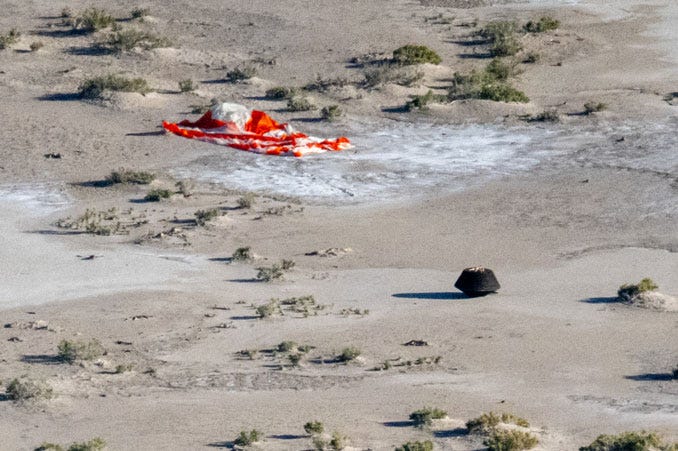
The OSIRISRex project (image at the top of the post) was a NASA sample gathering spacecraft which left the earth in 2016 to reach the asteroid called Bennu in 2018. In September 2023, during our performance, its collection capsule returned to earth with a 121g sample of material. This asteroid was selected because of the possibility that it was made up of carbonaceous material which could support amino acids and which might contain water. Amino acids, organic compounds necessary for life have been discovered in meteorite material on earth. The goal of this $800 million project was to gather pristine samples, untainted by organic precursors from Earth, to understand if indeed there was conditions for organic compounds and, potentially, life processes outside of our planetary bubble.
A myth of being. In the Choreographic Garden at Tangente, our whole world is in this nylon materials bag riding on a wheeled chariot. This is a fine play of scale. In the bag is the Earth. From a different index of scale come fungi-Nate and algae-Maria. They talk us, coaxing with words, through a transformative process. The Choreographic Garden seems to propose such infinite shifts and reverberations of scale.
In the classroom again. We are not reading but we are playing in this same field. There is no conclusion to frame the piece as a piece. There is only process. After the class students were asked to respond to this work with the prompt, “Connect the micro world of non-human nature to the macro world of human perception using Diego and Sybille’s dance work in combination with Llinas’ article on the sea squirt or Sheldrake’s article on lichen.” Some excerpts follow. (They are anonymized for privacy, but you know who you are. Thanks for your participation.)
[C.F.] …along with Hanna Sybille Müller’s The Choreographic Garden share is the idea of unraveling objective perspectives of nature we have constructed. Much like Noë, who writes about how human action creates patterns of thought and action (Noë, Strange Tools 19) The Choreographic Garden acts as a “strange tool” for reflecting on inherent forces of nature and life. … [Massumi] talks about an activist philosophy that rejects objective or subjective presuppositions, only asking what aspects of process an event exemplifies. …no preconceived ideas should be inherited from the performance, only the action that takes place within it… This performance crosses symbolic divisions between humans and nature - enacting a symbiotic relationship with the earth as a means of unraveling our individualistic notions of nature.
—
[G/G Mc] Returning to growth, the micro and macro. Humans exist at an interesting cross section of biology because of our self awareness. The lichen doesn’t know why it grows. The sea squirt doesn’t consciously choose to eat its own brain. […] We, on the other hand, are cursed with the burden of self-doubt. Through their work, though, Hanna and Diego break this down. They function together in a symbiosis with an emphasis on the feeling of nature. There is no questioning, just going. Do not question the part until you are whole. Do not question the algae until you see the lichen-covered rock.
—
[M-F B] These three artworks explore the concept of "becoming something else": In Biting Into a Piece of the Day, Toby Maclennan tries to blend into the room, to become a table, a chair, a painting. In Choreographic Garden, dancers attempt to experience life as if they were lichen. In After Caspar David Friedrich, the viewer merges with the gallery, the canvas, and the environment to transition to a new state, that of becoming one with the mystery. In these three works, there is a theme of transition, of paradigm shift. I believe that these transitions open up a conversation about how things could be, or are, different. How we are deeply influenced in our worldview by our senses and our perception of the everyday, but that this worldview can change. It can change with exercises of positionality. How are things "otherwise"?
—
[AA] This echoes Whitehead’s process philosophy which sees reality as a tissue of ongoing experiential events, creatively integrating what came before through “prehension” into each novel “occasion”… This interdependence of life/nature is well-explored in The Choreographic Garden, and its playful experimentation binding non-normative touch (unconstrained movement) with bags filled with soil. This echoes Llinas’ view of cognition rooted in motor control while creatively building new configurations. The work’s attempt to learn from and recreate plant-inspired movement also connects to Schelling’s conception of humanity’s inner identity with living Nature. Opening sensory experience to unfamiliar kinetic possibilities relates to Noë’s “strange tools” and materializes the continual holobiont mixing of boundaries between the micro/humans and the non-individual/environment. This evokes a porous quality, that demystifies the image of a fully delineated being.
—
[RB] Part of understanding what is taking place currently is having known what was to come, which brings back the idea that movement invents reality in that the brain perceives a future and reacts according to events it believes will take place. “The central generation of movement and the generation of mindness are deeply related; they are in fact different parts of the same process” (Llinás). Are we capable of separating the self from movement? Although Hanna and Diego’s piece tries (through personal separation of the perception of the self in reaction to environment), Llinás explains that so long as we move, we are mindful.
—
[AB]…Plants, as [Llinas] points out, have "well-organized circulatory systems but no hearts" and came into existence after most early animals, but they still intentionally chose not to have a nervous system even though they could. Therefore, the artists want to connect with them by utilizing the space that plants occupy with the bag of dirt to simulate how plants navigate and negotiate their own lived space. Through the artists' movements, I think they are creating (or re-creating) the organism's thoughts, with the 'here' being the choreography of Hanna and Diego as moving beings and the 'there' being represented with the dirt that the plants as non-moving beings occupy.
—
[XX] The process behind the work The Choreographic Garden, is a fascinating combination of both micro and non-individual worlds. It was explained that both dancers improvised their moves and tried to predict the movement of the other. In a way, they had to be in perfect union for the dance to function properly. The term symbiosis could be used to define the partnership of both dancers because both work together to thrive in the allocated environment properly. Additionally, while having to properly move across time, they must be fully aware of their partners' thoughts and movements, to be able to properly finish the improvised choreography.
—
[TK] Hanna and Diego’s work, The Choreographic Garden (2023) explores the continuity of movements between two bodies, which can be related to Sheldrake’s lichens as two organisms. The performance presents the natural reaction of the body from one movement to another, even though it might seem like there is no correlation, it’s an instinctual choreography almost like the sea squirts way of survival. The nervous system leads the sequence of the performance . Both bodies move together and create one singular continuous dance, if one stops moving or performing, the choreography cease to exist. They have to keep working as one, feeding off one another to survive.
—
[EM] This week, we are concerned with what is and isn’t a living thing… A human being, like a lichen, can be examined on its own, but doing so would be a disservice to how human beings function. We already reserve this mode of analysis for certain animals. The remora fish is understood through its relationship to the shark, and who could write anything at all about the remora without mention of the shark. We are dynamic creatures, and we grow and share according to our relationships to other beings…Thus, how could we understand our own consciousness without implicating more than ourselves?
—
[NR] The performance we saw of The Choreographic Garden (2023) lies in reaction as a kind of movement or nature. I saw each performer’s movement as a chain reaction. These reactions are a symbiotic process similar to Sheldrake’s description of lichen. To continue the piece, the performers need each other. Otherwise, there is no symbiosis. I'm also interested in the bags of dirt as part of the performance. It may be a stretch, but I wonder if the dirt is a prop or a fellow performer. I ask because if the answer is the latter, the dirt reacts naturally to the performers. … Beforehand, I was thinking of The Choreographic Garden as movements with intent. Now, I consider both the choreography and the reaction movements I described before as raw consciousness. The way the performers move, those actions are the mind itself. If the mind is matter, then dancing or choreography is also matter.
—
[SP] I think that The Choreographic Garden (2023) uses choreography built from the micro world and the non-individual, as a tool to make the viewer confront their understanding of nature. The movements were strange and fragmented, seemingly unnatural to the human body and how it typically moves through space and time. While the framework of the performance was planned, the individual movements were spontaneous and erratic. One person’s movement was cut off by another person and that decision affected the following movement.
—
[RD] Ideas present in Llinas’ and Sheldrake’s writings can be found in the The Choreographic Garden. This piece is an exploration of movements between two performers, creating a symbiotic relationship similar to that of lichen, albeit less tangible. Instead of nutrients and physical energy, the dancers provide movements that build on top of one another, keeping the performance in motion, i.e. alive. Like the sea squirt, there exists a shared goal within each dancer’s nervous system that allows these movements to be generated. This goal is described as “understanding plants and learning from them” (HSM).
—
[EB] Touching on subjects of nature and taking a new approach to movement, the dance engages with its viewers in a way that is difficult to interpret. Each motion is almost impossible to anticipate as the two performers react to each other and their environment through what could be called “erratic” movements. Their limbs touch, intertwine, and pull each other closer just as much as they push, repel, and avoid one another. It appears very unnatural in the way that humans touch each other yet relates to a more primitive and natural movement, like one of a plant or a cell. This reminds me of a lichen… Watching the two performers very much reminds me of watching two things merge together to become something nobody could have imagined; a lichen of sorts. Relating The Choreographic Garden (2023) to Llinas’ discussion of sea squirts creates a similar thought about movement. Llinas brings up an excellent point about movement: “The nervous system has evolved to provide a plan, one composed of goal-oriented, mostly short-lived predictions verified by moment-to-moment sensory input” (Llinas, 18)… This is the kind of movement which may be described as “erratic” during the performance. […] Every movement is half of what we would expect.
—
[PB] Hannah and Diego’s Choreographic Garden explores, in my view, a dimension of body and movement which I think is very similar to Rodolfo Llinas’ theory of movement and thought: Llinas’ idea that living, moving bodies are able to develop thought/agency over their fate only because they are powered by a microscopic chain reaction of electrical impulses relates directly to the viscerality of the Choreographic Garden, which seeks to attain a form of intuitive bodily expression detached from any kind of rational or theorized planning of movement and instead breaking down the performance to its most fundamental impulses.