
9 - Three Guest Practices (#1)
1 - Limited Immunity by Andre Jodoin
This post is the first of three guest writers or artists, a consideration of three specific artworks which seem to have a connection to nature as an idea of the real. The artworks are connected by a familiarity - they are a community. Not that the artists know each other but that the works form a ground for thinking. Here are three guest-works presented with a view to working out how far we can go with the practices themselves, as if we see thinking about the work as being part of the ‘doings and sayings’ of the practice (see Schatzki in post 3).
First, Andre Jodoin writes about an animal artwork of mine. It extends this work in a richly different sense from what I had imagined. Second, I discuss the cowhide works of artist Mindy Yan Miller. This is guided by an exhibition I organized as a way of thinking through her work . Thirdly, choreographers Hanna Sybille Müller and Diego Gil came to the class to discuss Sybille’s work in progress ‘The Choreographic Garden.’ I discuss this project, in which I was a peripheral participant, and share student reactions. (A.F.)
—
ANDRE JODOIN is an artist and writer living in Toronto. He writes:
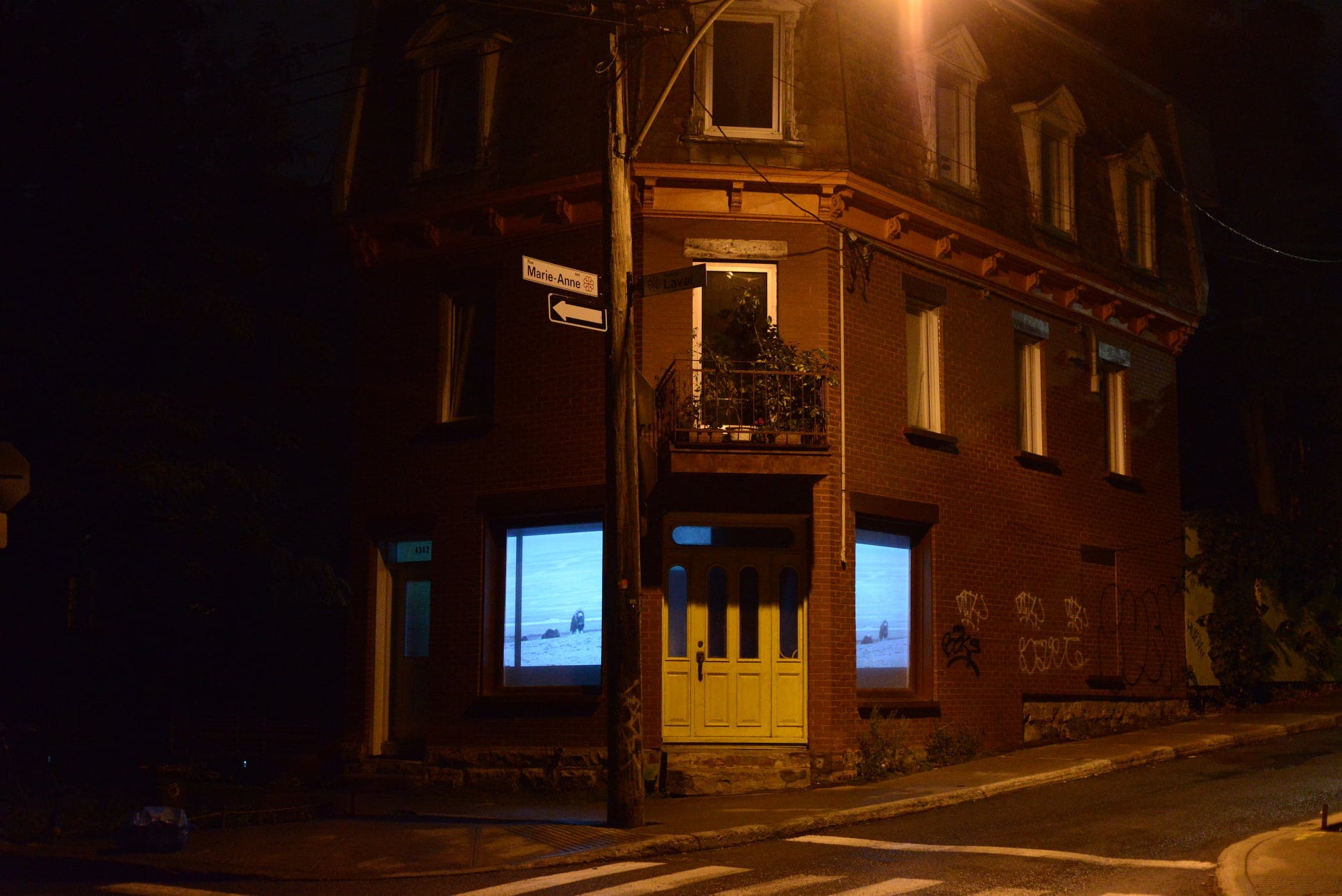
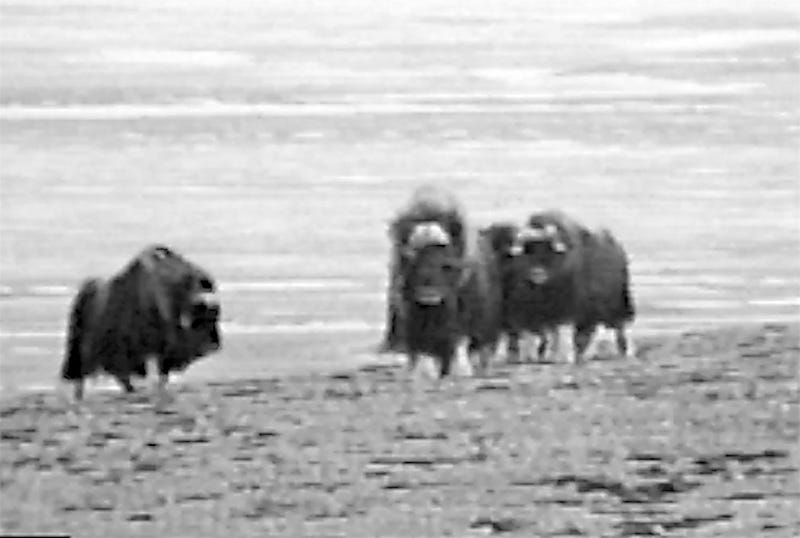
Limited Immunity has two modalities, neither of which involve conventional gallery exhibition. One modality is comprised of two video projections on the ground floor in a residential triplex that is viewed from the street. The other modality is an online web page that includes the street mode video and a text. Andrew conceived of the work in relation to his experience of visiting a muskoxen herd on Bathurst Island, Nunavut. The work drops out of the gallery/museum world in order to appeal to viewers who are mobile and involved in various mundane activities such as going shopping, walking dogs, checking email, etc. Their activities differ significantly from the gallery/ museum’s assumption of a static observer. These viewers are better described as audiences. The artist makes an analogy between the muskoxen grazing on the tundra and cellphone users strolling down the street while consulting the internet.
In philosophy, Gilles Deleuze and Félix Guattari addressed animality as an issue in the early 80s in their book A Thousand Plateaus: Capitalism and Schizophrenia. They describe the animal experience as pre-individual. A herd is not, of course, a formal association of subjects but an expression of instinct, affection, and bodies. The animal world is largely immanent, lived with little self-consciousness and without reflection or representation. Forster’s interested in this animal being and how humans obliquely experience their own animality through moments of becoming animal in everyday living.
Limited Immunity is a work that is dispersed among Bathurst Island, a neighbourhood site in Montreal, the World Wide Web and the databases of funding agencies. It is formally similar to the dispersed works of the American artist Michael Asher. However, where Asher’s subject is the institution of the gallery/ museum, Andrew focuses on the industrial aspect of the culture industry by incorporating reference to the work’s own documentation. Documentation, such as photographs and texts, is a standard that informs the mediation of the work in the marketplace. In other words, a documented artwork is a standard artwork in the marketplace.
Standardization does not imply or require serial production. Documentation simply creates and imposes a system of indices that position an artwork in relation to the market. It is a binary system: documentation is not itself identical to the work and does not replace it. However, this also means that, at least in the marketplace, the work becomes dependent in some ways on the documentation to be art. For instance, the photograph of Duchamp’s Fountain in 1917 (photographed by Stieglitz) is a document of the ready-made that was lost. Without that photograph, the Schwarz edition of Fountain in 1964 would have no traction. The standard work of Limited Immunity is delimited by two spatially and temporally discontinuous modes. One employs the video being projected on the ground floor vitrines of a residential triplex (the street mode). The other combines the video with text published to a web page (the web mode).
For the street mode, the video reveals the muskoxen in wild habitat: the muskoxen in the distance; the artist’s considered approach to the herd; the reactions of the muskoxen; and the muskoxen moving off to another grazing area. Limited Immunity is viewed at L’Endroit indiqué, the name given to a repurposed storefront in a building situated in Montreal’s Plateau neighbourhood. Located at an irregular corner building, the venue defines a zone that allows audience members to arrive from different directions. There are two vitrines on either side of the corner that display the same video projection. The zone is comparable to the environs of an outdoor public monument. Public monuments are normally organized around a central figure to gain attention and focus but L’Endroit indiqué engages audiences through their pedestrian routines and discarded observations of the streets: a pedestrian strolling past apartment buildings suddenly catches sight of a flickering TV screen; attention turns from the architectural environment to a stream of broadcast images such as a hockey game or a movie. The majority of the people who experience the street mode live in the neighbourhood. They see the work on a regular basis, actually sustain it, but without the express purpose of seeing art.
The first moment of viewing Limited Immunity opens an unexpected lateral relation between the audience and the muskoxen, invoking puzzlement and caution. The muskoxen are not familiar. Their massive size and facial physiognomy intrude on the street corner. As audiences engage with the video more closely, the viewing situation changes. The audience slips into becoming the unseen artist by way of the muskoxen’ obvious interest in him. To be animal means to be caught up in a security network of looks and glances. Identifying with the camera movement, the audience passes from a lateral relation to that of being observed point-blank by the muskoxen. Complex artifice has been used to create a simple, seemingly direct impression of the muskoxen’s acceptance of the audience as another animal. It is an optic to which the audience can return, attuning themselves to being animal.
In contrast, the web mode is only accessed from mobile phones or computers. The web page of Limited Immunity combines the muskoxen video with a text drawn from a scientific study. The language element introduces a dimension that is absent from the street mode. The authoritative text offers a directed view of the video, suggesting that audiences interpret the video using terms and concepts provided by the text. Using language is a common way of being human. The eye movement on the web page between the text and the video simulates the process of verification in documentation. The web mode’s language elements are forgetful of being animal and transforms the street mode into what I define above as a standard work.
The distance observed between the street mode and the web mode, what Andrew refers to in other writing as the difference between the immanent and the symbolic, is huge. It is difficult to express the brute fact of human animal existence. Eadweard Muybridge attempted this in his work Animal Locomotion. Although his approach was framed in terms of a scientific program, the execution of the photographs goes beyond the framework by his set-up of visual comparisons of animal movements. What feels particularly important about Andrew’s work is the value he gives to the immanence of the photographic image over against the general trend to build works for photographic reproduction. (Andre Jodoin)